Plan a Family Gathering Around One Shared Ritual
Plan a family gathering around one shared ritual with clear timing, simple materials, and practical ways to join, so the custom fits the room and the day.
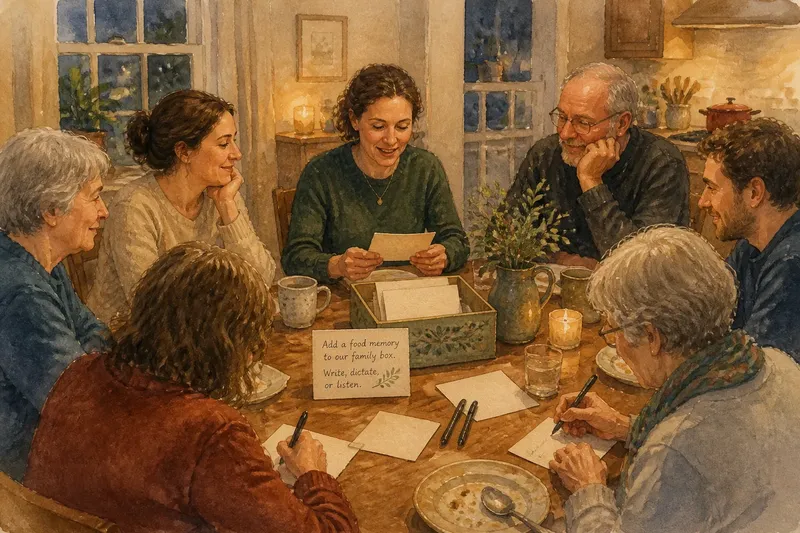
A pot of soup is cooling on the stove while relatives arrive with damp coats and bags of bread. You have planned a family gathering around one shared ritual: each person may add a memory to a small box of recipe cards kept for the occasion. The idea is simple; the hosting still needs a little choreography.
Good logistics keep a ritual from competing with dinner, arrivals, accessibility, or the ordinary fact that families rarely enter a room at the same pace. Decide where the materials go, when the moment happens, who introduces it, and what happens afterward. The ritual can then take up its proper amount of space: enough to be noticed, not enough to require stage management.
How do you plan a family gathering around one shared ritual?
Start with the practical shape of the gathering, not a decorative concept. Choose one action and make a short run-through in your mind: where people will be, what they need to see or handle, how long the moment is likely to occupy, and how the gathering returns to its usual rhythm.
- Check the room layout; if everyone can see the ritual’s focal point, use it, and if not, move the focal point or gather people in a smaller space.
- Check the available surface; if the cards, bowl, candle, or other object fits safely, set it there, and if not, use a smaller object or a different surface.
- Check the timing against arrivals and food; if most guests can be present, place the ritual there, and if not, choose a moment when late arrivals will not be put on display.
- Check whether guests need to hear or see instructions; if the room is quiet and visible, give one brief introduction, and if not, lower background noise or use a written prompt.
- Check whether the action involves food, touch, standing, or speaking; if those suit the group, proceed as planned, and if not, provide another way to take part.
- Check who will handle setup and cleanup; if one person can do both without missing the gathering, assign the task, and if not, ask a willing helper or simplify the materials.
Send a plain note before the day if guests might otherwise be surprised. State what will happen, when it will happen, and whether anyone is expected to contribute. “After dinner, we’ll add a recipe card to the family box; writing, listening, or simply staying nearby are all fine” gives guests useful information without turning the invitation into a contract.
Where should the ritual fit in the schedule?
Choose a moment that has a natural beginning and end. Before dessert may work if the meal is relaxed; just after everyone arrives may not, since guests are still finding coats, seats, and the bathroom. A ritual that relies on a quiet pause should not be placed beside a blender or a toddler’s urgent announcement about a spoon.
Leave a little flexibility around the chosen moment. If one guest is delayed, the host can decide whether to wait, begin with whoever is present, or move the ritual later. Make that choice in advance where possible, especially if waiting could make another guest uncomfortable.
Keep the transition explicit. The host can say, “Before we clear the table, I’d like to add a card to the recipe box,” then explain the action in a sentence. Afterward, name the next ordinary activity: coffee, dessert, or clearing plates. People should not have to guess whether the ceremony has ended.
What materials and roles should you prepare?
Use only materials the ritual needs. For a recipe-card custom, that might mean blank cards, pens that write clearly, and a box or envelope. Put them where guests can reach them without blocking the food or making a queue in a narrow doorway.
Give each host task to a person who can actually manage it. One person might introduce the ritual; another might keep the cards and pens in place. Avoid assigning a guest to prompt everyone for contributions unless that job is genuinely welcome. A host who is also cooking may need the ritual to run without a last-minute search for a working pen.
Make the instructions visible if the action has several parts. A small card with a sentence such as “Write a recipe or food memory; names are optional” can spare the host from repeating directions over the clatter of dishes. Skip elaborate labels, coordinated stationery, and a special container if the family box already serves the purpose. They are not worth the effort unless they solve a real hosting problem.
How can guests participate without being put on the spot?
Offer different ways to meet the ritual, and describe them as ordinary options rather than substitutes. A guest might write, dictate a note to the host, read a card, help place the box on the table, or simply listen. Do not ask anyone to explain a choice.
Think through access and comfort before the gathering. If someone has difficulty hearing in a busy room, reduce competing noise or repeat the brief introduction. If standing is uncomfortable, keep the activity seated. If writing is difficult, offer to take dictation privately or let the person contribute in another way. For food customs, do not make anyone account for dietary needs in front of the group.
Say plainly that participation is optional. Then behave as if you mean it: do not circle back to a quiet guest, hand them a pen, and wait. A low-pressure invitation is useful only if the host leaves room for a no.
What should the host do before, during, and after the ritual?
Before guests arrive, set out the materials and check the route to the activity. During the gathering, give a short explanation, demonstrate the first action if needed, and let the room respond at its own pace. When the moment ends, put the materials away or leave them available by choice, then continue with the meal.
Say you are hosting a dinner for relatives who share a recipe box, and the planned ritual is to add one food memory. For this invented situation, the starting inputs are six blank index cards, two pens, a shallow box, and a dining table with room for the box but not for a standing circle. Before dinner, you place the box and cards at the table’s end and write a note explaining that guests may contribute, dictate, or listen. After dessert, you explain the purpose in one sentence, add your own card first, and leave the pens where seated guests can reach them. Two relatives write cards, one dictates a note to you, and the others listen; the resulting decision is to keep the ritual seated and the same length at a future dinner, while asking a helper to write any dictated note so you are not managing both the conversation and the materials.
After the gathering, consider the logistics rather than grading anyone’s feelings. Were the materials easy to reach? Did the timing interrupt something important? Did the instructions make sense without repeated explanation? If a part caused friction, adjust that part next time. There is no need to turn a family ritual into a performance review, a genre with few natural fans.
What questions come up when hosting a family ritual?
How far in advance should guests hear about the ritual?
Give notice when the ritual involves a personal memory, food, faith, touch, or speaking in front of others. A short message before the gathering lets guests understand the plan and decide how they want to participate.
What if the room is too noisy for a spoken ritual?
Move to a quieter moment or place, turn off competing audio, and keep the spoken part brief. If the room will remain noisy, use a written prompt or have the host repeat contributions for anyone who wants to hear them.
What if the ritual takes longer than expected?
Decide in advance what can be shortened, such as limiting the host’s introduction or leaving additional contributions for later. End the moment clearly rather than rushing guests who are in the middle of taking part.
How should the host include relatives who cannot attend?
Offer a simple option, such as accepting a note beforehand, or share what the gathering plans to do afterward. Ask before reading someone’s message aloud; sending a contribution does not automatically mean giving permission to make it public.
What is useful to notice for next time?
After cleanup, make a brief note about timing, materials, and access while the details are still clear. Record practical observations: the box was hard to reach, the instructions needed repeating, or the ritual fit naturally before dessert. Do not infer that a quiet guest disliked it, or that a lively response means every guest wants the same arrangement again.
For a family gathering around one shared ritual, good hosting is mostly a matter of removing avoidable friction. Keep the materials simple, state the plan, make the moment easy to enter and easy to leave, and let the gathering resume without a demand for commentary. The recipe box can stay on the shelf until next time; it does not need to sit in the center of every conversation.