How Household Recipes Traveled Before Printed Cookbooks
Household recipes before printed cookbooks traveled through ingredients, utensils, and handwritten working copies; learn how cooks adapted them to local kitchens.
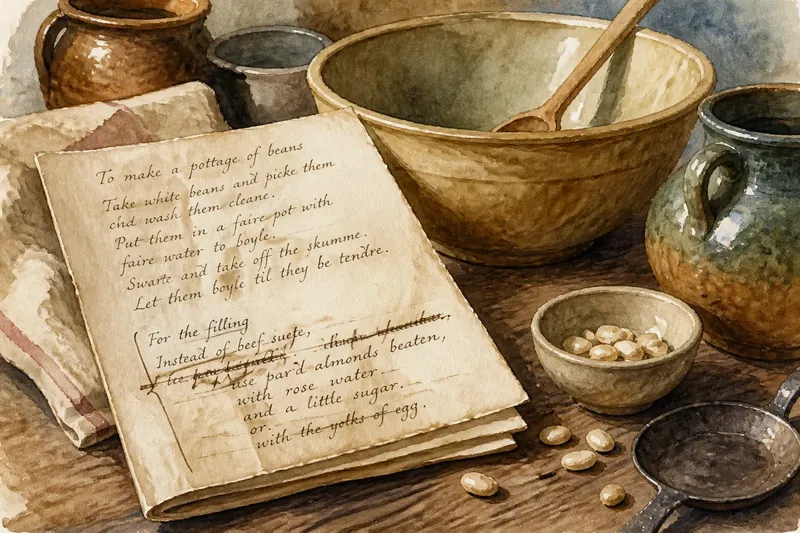
A folded recipe leaf sits beside a mixing bowl, its margin crowded with a change to the filling. Household recipes before printed cookbooks did not follow one universal route: in particular households and periods, they might be taught at the stove, copied into a manuscript collection, or kept as a short working note. The useful question is not whether every cook relied on memory, but what kind of record a cook had and what it was meant to do.
Handwritten recipe collections existed alongside spoken instruction and practical cooking. Their entries could list ingredients and operations, yet leave choices such as heat, texture, or vessel to the cook. That gap is not merely a failure of writing. It points to the difference between recording a dish and specifying every condition needed to reproduce it.
What did a handwritten recipe actually record?
A manuscript recipe might name ingredients, describe an order of work, or give a cue for judging readiness. The level of detail varied by writer and purpose. A note intended for a cook already familiar with a dish could be terse; one meant to preserve an unfamiliar preparation might explain more.
Recipes were also copied and revised. A copied entry could acquire a changed ingredient, an added caution, or a different instruction. The page therefore records a version of a method, not necessarily an authoritative original. Handwriting, omissions, and corrections can all be evidence of how someone used the recipe, though they do not tell the whole story.
Why do old recipes leave so much to judgment?
Some instructions describe a result rather than a fixed setting: cook until tender, add liquid gradually, or bake until the surface changes. Those directions require the cook to observe the food and respond. A pan, oven, ingredient, and local habit all affect what the words mean in practice.
Even a quantity that looks definite may depend on context. A vessel named in a manuscript could be familiar to its first users but unclear to a later reader. Where the text does not specify capacity or preparation, assigning it a modern exact equivalent can imply certainty the source does not provide.
How did a recipe change as it moved between kitchens?
Ingredients and equipment shaped what could be made. A cook might adjust a preparation to the grain, fat, cookware, or heating method available, while keeping its recognizable sequence or intended texture. Such changes could preserve a dish’s identity for a household without producing an identical result in every kitchen.
Imagine a reader finds a manuscript instruction for a thickened bean dish that calls for a heavy pot and says to cook until the beans soften. The reader’s starting point is the written instruction, a different pot, and beans that remain firm after the liquid begins to reduce. They lower the heat, add liquid as needed, and keep cooking until the beans soften; the result follows the recipe’s stated cue, though the timing and amount of liquid differ. This invented situation shows the tradeoff: the written endpoint can guide adaptation, but it cannot supply missing details about the original kitchen.
How should you read an old recipe today?
Start with the document rather than an imagined standard version. Note what it says plainly, what it leaves open, and whether a correction or alternative appears in the text. If the source is difficult to read, compare the handwriting and wording across the same page before deciding that an odd phrase is an ingredient or an instruction.
- Check whether the recipe names a vessel; if its size is not stated, treat the quantity as context-dependent, and avoid claiming an exact conversion.
- Check whether the ingredients are listed in an order; if the sequence is clear, preserve it, and if it is not, mark the uncertainty rather than silently inventing one.
- Check for words describing texture or readiness; if a result cue appears, use it to interpret the method, and if none appears, acknowledge that the endpoint is unspecified.
- Check whether a quantity has been crossed out or amended; if the change is legible, record both versions, and if it is not, leave the reading unresolved.
- Check whether an ingredient name has an uncertain meaning; if the document or its surrounding entries clarify it, use that context cautiously, and otherwise do not substitute a modern ingredient as though the match were certain.
- Check whether the recipe mentions a particular pot, heat source, or preparation; if it does, retain that condition in your interpretation, and if it does not, avoid attributing a specific setup to the writer.
What is not worth the effort is forcing every phrase into a modern measurement or a single definitive reconstruction. A careful transcription that distinguishes clear instructions from missing information is more useful than a confident conversion built on assumptions.
What do readers ask about household recipes before printed cookbooks?
Were old household recipes always passed down orally?
No. Some were written in manuscript collections or working notes, while spoken teaching and written records could coexist. The surviving form depends on the household, the purpose of the recipe, and what records remain.
Why do manuscript recipes sometimes omit quantities?
A recipe could be written for someone who already knew the ingredients or technique, and its writer might consider a texture or cooking cue more useful than a fixed amount. The omission does not establish that all cooks of the period worked in the same way.
Can an old recipe be converted exactly to modern measurements?
Only when the source provides enough information to support the conversion. If a vessel, ingredient, or term is unclear, an exact-looking modern figure may conceal rather than resolve the uncertainty.
What can a correction in a recipe manuscript tell us?
It can show that someone altered or clarified the written entry, but not necessarily why or whether the change was used successfully. Treat the correction as part of the document’s history, not as proof of a final standard version.
What makes a recipe worth preserving?
A household recipe could endure as a working document: copied, annotated, adjusted, or consulted when a dish was needed. Its significance lies not only in whether every detail survived, but also in the decisions it records and the questions it leaves for a later reader.
When you interpret household recipes before printed cookbooks, keep the source’s limits visible. Record what the page states, separate it from your own reconstruction, and preserve uncertain readings alongside plausible alternatives. That small distinction lets the recipe remain useful without pretending the missing kitchen is still there.