The Myth That Traditions Never Change
Traditions change as people carry them forward. Learn how to tell gradual adaptation from a break in meaning, and what a community can preserve.
At a neighborhood gathering, the old song begins in a language few children understand. An older neighbor suggests keeping the original verse and adding a translation. The tune remains; the way people enter it changes. Traditions rarely travel unchanged, even when their participants describe them as ancient.
The interesting question is not whether a custom has changed. It is how change happens, who carries it, and which traces of earlier versions remain. Seen that way, tradition is less like a sealed heirloom and more like a path worn by people using it.
Why do traditions change as they travel?
People inherit practices in particular places and circumstances, then carry them into new ones. A recipe moves with a family; a seasonal observance follows a community to another climate; a saying survives after the work it once described has disappeared. The surrounding conditions change, so participants make choices, sometimes deliberately and sometimes without noticing.
Change can enter through translation, new materials, different schedules, migration, technology, or the arrival of people who were previously outside the practice. It can also come from ordinary variation: one person remembers a verse differently, a tool is unavailable, or a local custom meets another one. Repetition does not prevent change. It is often the means by which change is passed along.
That does not mean every alteration is a continuation. A practice can keep its name while losing the actions and meanings that made it recognizable. The history lies in the relationship between versions, not in a label alone.
How can you tell continuity from simple sameness?
Continuity does not require every detail to match an earlier version. It requires some intelligible connection: people recognize an inherited pattern, refer to its earlier forms, or understand what the practice is carrying forward. Sometimes the connection is a gesture or a sequence. Sometimes it is a story about why a particular object or phrase remains.
Look at what participants actually do, not only what they say a tradition means. A harvest meal might retain a shared dish while its setting and guest list change. The dish can link generations, but if nobody knows why it is served, the connection may be more fragile than the familiar name suggests. Asking who taught the practice and what they remember can surface several versions rather than one official account.
Disagreement is part of that record. One generation may call a change a loss; another may see it as the reason the practice remains usable. Neither response settles the matter by itself. It does, however, show that a tradition is being interpreted rather than merely copied.
What should you ask when a tradition changes?
How do I find out which version came first?
Ask participants where they learned the practice and what they remember changing. Compare family accounts, local records, old programs, recipes, or objects if those are available, while allowing for gaps and conflicting memories.
Can a new version still be traditional?
Yes, if people can explain its relationship to earlier practice and take it up as part of shared inheritance. A new form with no acknowledged connection may be a worthwhile custom, but calling it old does not make it so.
What if people remember the past differently?
Keep the disagreement visible instead of forcing one account to stand for everyone. Different memories can show how the practice varied across households, places, or generations.
When has a tradition become something else?
There is no universal boundary, but a change in purpose, participants, or central actions may make the old name misleading. If people no longer recognize a meaningful link to earlier practice, it may be clearer to describe the result as a new custom.
How can you trace a tradition without freezing it?
A brief record can help people see adaptation as a history rather than a mistake. Note what participants do, what they say it means, and which details vary. The point is not to appoint a final authority. It is to make the handoffs and alterations easier to understand.
- Who taught the practice? If participants name several teachers or sources, record the different versions; if they name none, ask what account or object could help establish its history.
- Which actions recur? If the same gesture, sequence, or shared task appears across versions, record it as a point of continuity; if actions differ, note the variation rather than choosing one as the sole original.
- Which details have changed? If participants can identify a reason, record the reason alongside the change; if no one knows, mark it as uncertain instead of inventing an explanation.
- Who takes part now? If participation has broadened, record how newcomers learned the practice; if people are absent or unsure how to join, ask what information or invitation is missing.
- What objects or words carry memory? If people attach specific stories to them, preserve those accounts with the item or phrase; if the connection is unclear, ask before discarding or replacing it.
- How do accounts differ? If memories conflict, retain the distinct accounts and identify who remembers each version; if they agree, note the shared account without treating agreement as proof that no other version existed.
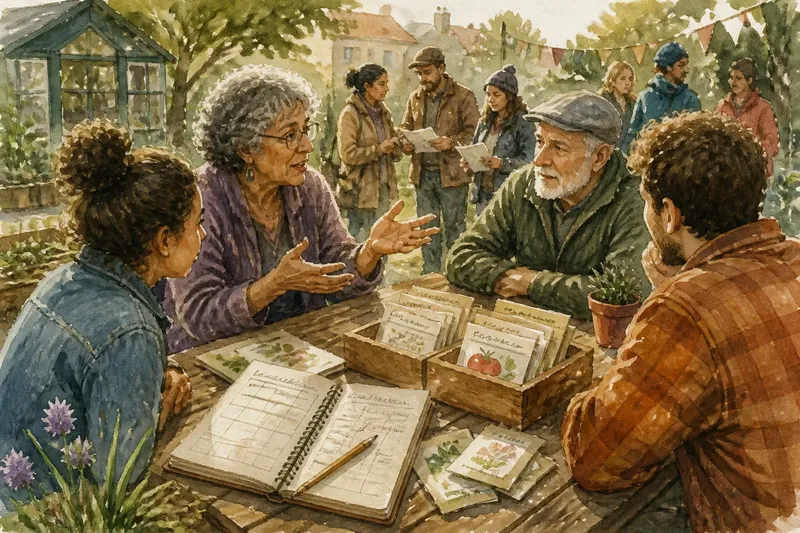
Imagine a small community garden whose members have passed down a seed-sharing day. The starting materials are an old notebook with a planting calendar, a box of labeled envelopes, and two conflicting memories about whether the gathering included a meal. The group reads the calendar, asks the two longtime members to describe what they recall, and keeps both accounts in its notes. Members then continue exchanging labeled seeds, add a simple explanation of each variety for newcomers, and leave the meal optional. The resulting record shows a clear thread in the exchange of seeds, a changed way of teaching, and an unresolved detail about food; it does not pretend to recover a single perfect original.
What is not worth the effort is forcing every version into a tidy origin story. Traditions often have ordinary, uneven histories, and a neat account can hide the people who remember them differently. A careful note that says “we do not know” is more useful than an invented certainty.
What can a community preserve while allowing change?
Preserving a tradition need not mean preserving every old arrangement. People can keep accounts of earlier versions, retain objects that carry particular memories, and teach the practice in a way that names both inheritance and alteration. Those choices make change visible without treating it as contamination.
For a tradition to travel, someone must be able to learn it and make sense of it. Explain unfamiliar words, name the sources people know, and leave room for participants to describe what the practice means to them. If a custom changes again, the next account can include that change rather than pretending the present version arrived untouched.
The myth that traditions never change often comes from seeing only the version currently in use. A closer look reveals people choosing, forgetting, translating, and remembering along the way. To understand a tradition, follow those handoffs; the history is not just what stayed the same, but how people made it theirs.